Showing posts with label SpaceX's Falcon Heavy. Show all posts

Mars on Earth: Tests in Desert of Oman
Mars on Earth: Tests in Desert of Oman

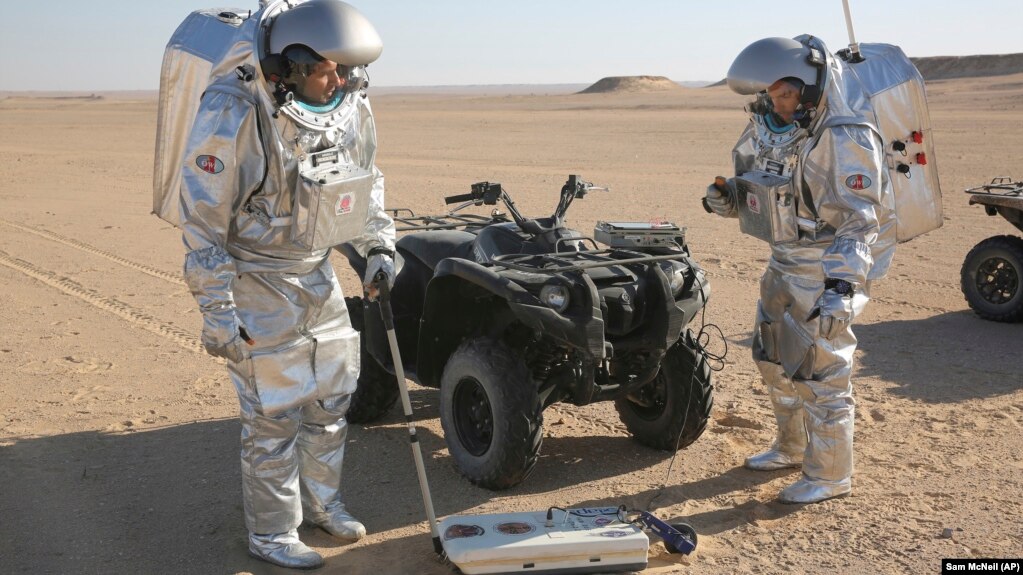
Two scientists test space suits and a device called a geo-radar for use in a future Mars mission in the Dhofar desert of southern Oman.Two scientists test space suits and a device called a geo-radar for use in a future Mars mission in the Dhofar desert of southern Oman.


Two scientists work together to test a geo-radar that was built to make a map of the planet Mars. They pull the flat box across rocky, sandy ground. They are wearing spacesuits, just like astronauts do in space. The bright white on their protective equipment stands out against the color of the sand and dirt.
When the geo-radar stops working, the two walk back to their vehicles and use a radio to contact scientists at a nearby base camp for guidance. They are unable to speak directly with their command station, which is far away in the European Alps. Communications from there are delayed 10 minutes.
The scientists are not on the planet Mars. They are in a desert in southern Oman, near the borders of Yemen and Saudi Arabia. The desert looks so much like Mars that scientists chose it to field-test technology for a manned space flight to the red planet.
Efforts to send astronauts to Mars
The United States government and a few American companies have established programs to send astronauts to Mars. Former U.S. President Barack Obama and SpaceX founder Elon Musk have both declared that astronauts would walk on the planet in just a few decades.
China is joining the U.S. and Russia in space with its own Mars program. And aerospace companies like Blue Origin have published plans for future bases, ships and spacesuits.
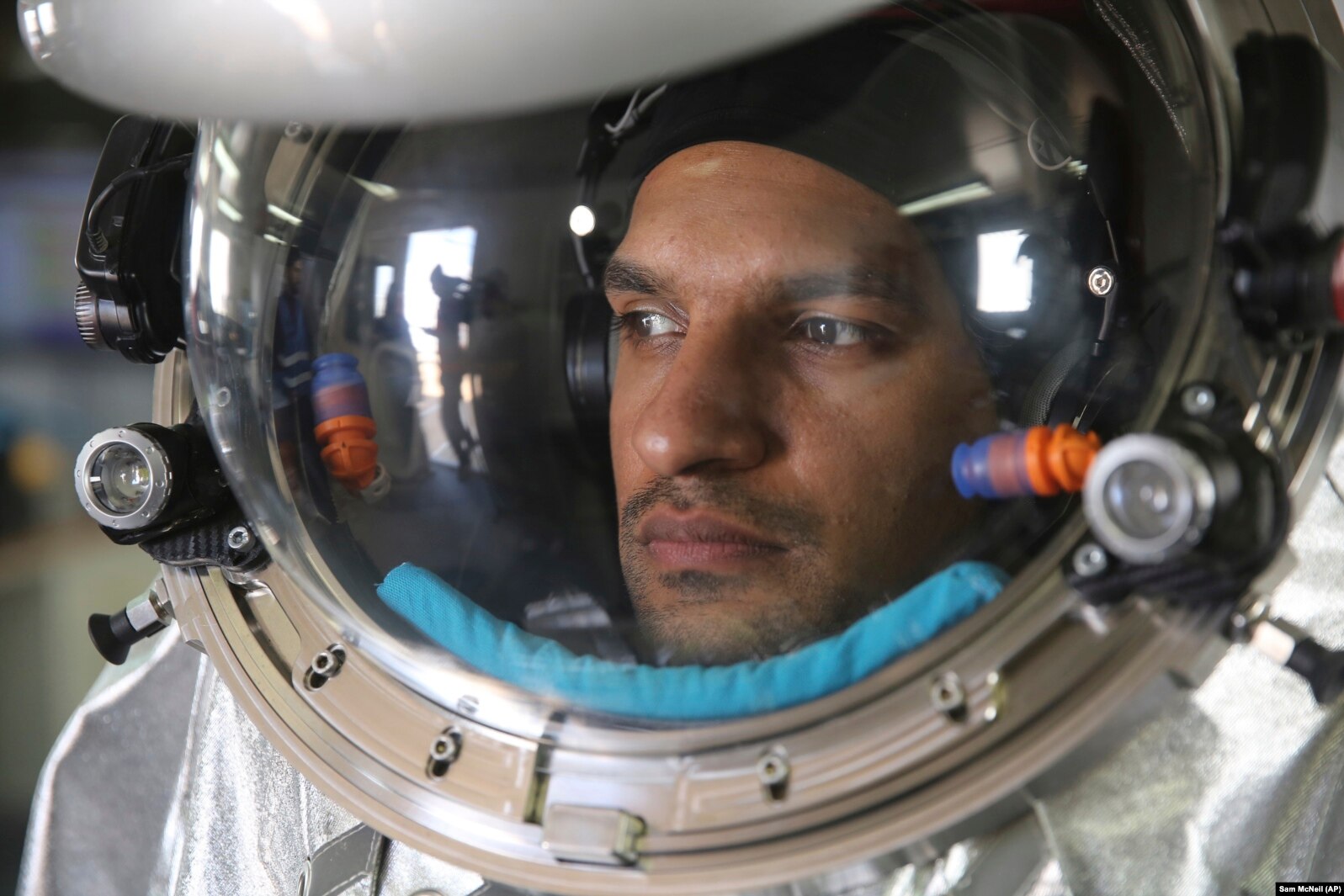

Analog astronaut Kartik Kumar wears an experimental space suit during a simulation of a future Mars mission in the Dhofar desert of southern Oman.

Last week’s successful launch of SpaceX's Falcon Heavy rocket “puts us in a completely different realm of what we can put into deep space,” says Kartik Kumar. He is an analog astronaut.
Analog astronauts carry out tests in preparation for a Mars space flight. The next step after the rocket test, Kumar says, is to deal with non-engineering problems, such as how to react to a medical emergency in space.
“These are things I think can’t be underestimated,” Kumar noted.
Testing for possible Mars mission
Most of the work to prepare for interplanetary trips is being done on Earth. Our planet’s deserts provide some of the best environments to field-test equipment and people for the trip to Mars.
From space, the Dhofar Desert is a flat, brown area. Few animals or plants can survive in this part of the Arabian Peninsula. Temperatures can top 51 degrees Celsius.
On the eastern edge of a seemingly endless sand dune is the Oman Mars Base. The base is a huge, self-contained area in which people live and work. It is surrounded by shipping containers, which serve as laboratories and living space for the crew.
The desert’s surface looks so much like Mars that it can be hard to tell the difference, Kumar said. Its salt domes and riverbeds, he said, look like “a lot of what we see on Mars.”
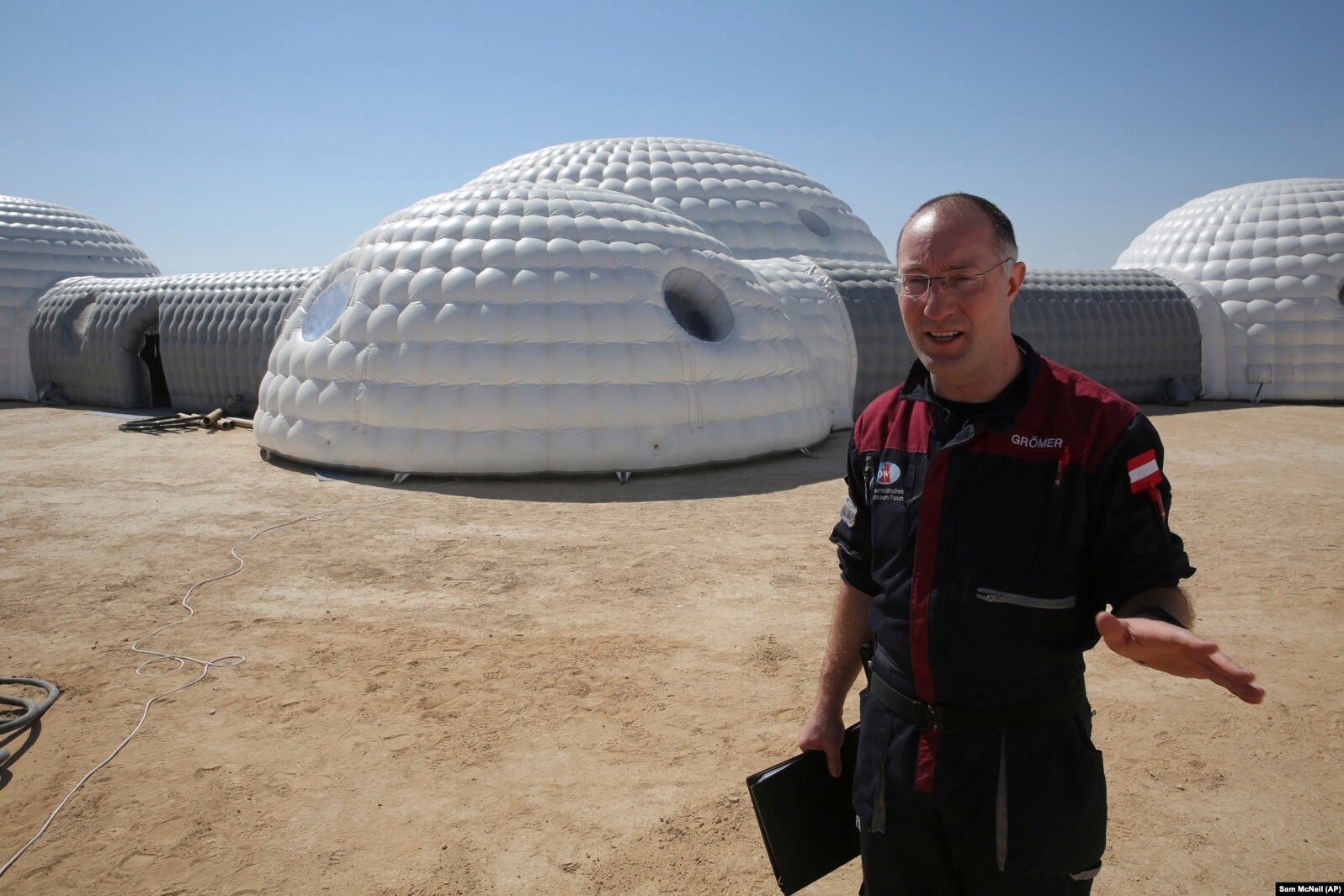

Gernot Groemer, commander of the AMADEE-18 Mars simulation in the Dhofar desert of southern Oman.

Oman’s government offered to host the Austrian Space Forum’s next Mars simulation. The offer came at a meeting of the United Nations Committee on the Peaceful Uses of Outer Space.
Gernot Groemer, commander of the Oman Mars simulation, said his group quickly accepted.
Scientists from across the world sent ideas for experiments. The project quickly grew to 16 scientific experiments, including testing a new spacesuit called Aouda.
The spacesuit weighs about 50 kilograms. It is called a “personal spaceship” because one can breathe, eat and do complex science inside of it. The suit’s visor can show maps, communications and sensor information.
Unusual test sites
The Soviet Union’s 1957 launch of Sputnik led to a space race with the goal of putting people on the Moon.
But before the American space agency NASA got there, astronauts like Neil Armstrong trained while suspended on pulleys, or lifts, to simulate one-sixth of Earth’s gravity.
Scientists used hostile environments in places like Arizona and Siberia to test space capsules, landers, and suits — simulating dangers found beyond Earth.
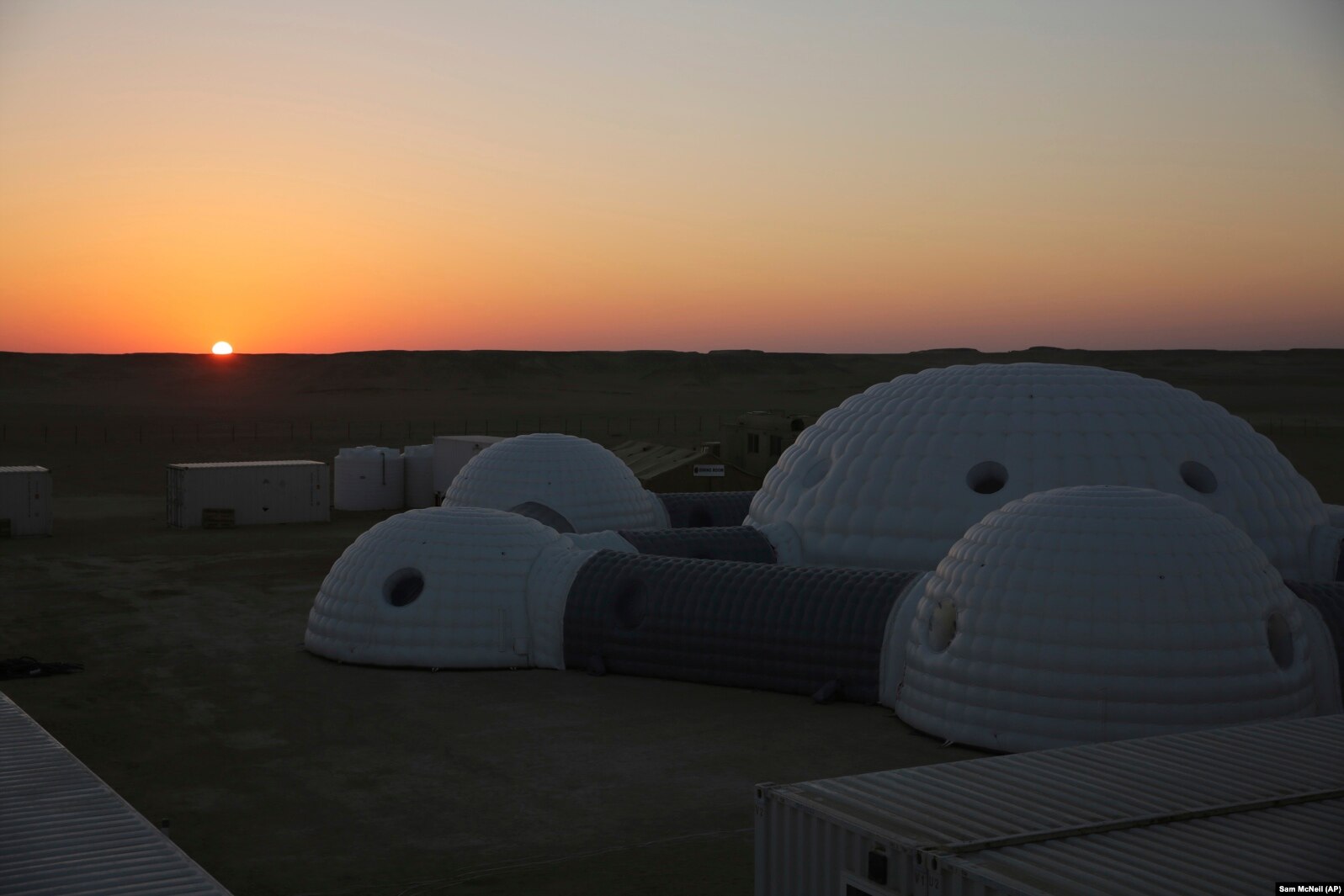

The sun rises over a 2.4-ton inflated structure used by the AMADEE-18 Mars simulation in the Dhofar desert of southern Oman.

Among many Mars scientists, a favorite book is “Packing For Mars,” by Mary Roach. The book notes that test space stations have been built underwater off the coast of Florida, in dark and cold deserts in Antarctica, and in volcanic craters in Hawaii.
NASA scientists used the Mojave Desert in the western U.S. to test vehicles meant for Mars. The scientists also found out a lot about how humans can adapt to different environments.
“Human’s adaptability in an unstructured environment is still far, far better than any robot we can send to space,” said Scott Hubbard, who once led the U.S. space agency’s Mars program.
Hubbard added that people, not just robots, are important to exploring Mars.


I'm Anna Matteo. And I'm Pete Musto.
Samuel McNeil reported this story for the Associated Press (AP). George Grow adapted the report for VOA Learning English. Ashley Thompson was the editor.

SpaceX's Falcon Heavy, the World's Biggest Rocket, Soars in Maiden Test Flight

SpaceX's Falcon Heavy, the World's Biggest Rocket, Soars in Maiden Test Flight
 
The world's most powerful rocket, SpaceX's Falcon Heavy, blasted off Tuesday on its highly anticipated maiden test flight, carrying CEO Elon Musk's cherry red Tesla Roadster toward an orbit near Mars.
Screams and cheers erupted at mission control in Cape Canaveral, Florida as the massive rocket fired its 27 engines and rumbled into the blue sky over the same NASA launchpad that served as a base for the US missions to the Moon four decades ago.
"The mission went as well as one could have hoped," an ecstatic Musk told reporters after the launch, calling it "probably the most exciting thing I have seen literally ever."
"I had this image of a giant explosion on the pad with a wheel bouncing down the road with the Tesla logo landing somewhere," he said. "Fortunately that is not what happened."
Loaded with Musk's red Tesla and a mannequin in a spacesuit, the monster rocket's historic test voyage captured the world's imagination.
SpaceX's webcast showed the Tesla Roadster soaring into space, as David Bowie's "Space Oddity" played in the background -- with the words "DON'T PANIC" visible on the dashboard, in an apparent nod to the sci-fi series the "Hitchhiker's Guide to the Galaxy."
Musk posted a live video showing the "Starman" mannequin appearing to cruise, its gloved hand on the wheel, through the darkness of space, with the Earth's image reflected on the car's glossy red surface.


If the Roadster survives its five-hour journey through the Van Allen Belt -- a region of high radiation where it will be pelted with charged particles -- it will attempt a final burn toward Mars, Musk said.
Then, the car would enter an orbit around the Sun that brings it close to Mars, on a journey that could last a billion years and take it as far as 250 million miles (400 million kilometres) from Earth, the same as a trip around the equator 10,000 times.
"Maybe it will be discovered by some future alien race," Musk told reporters. "What were these guys doing? Did they worship this car?" he mused.
More about the status of the car's journey is expected in the coming hours.
The Roadster was also outfitted with a data storage unit containing Isaac Asimov's science fiction book series, the Foundation Trilogy, and a plaque bearing the names of 6,000 SpaceX employees.
falcon heavy reuters full Falcon
'Giant step'
About two minutes into the flight, the two side boosters peeled away from the centre core and made their way back toward Earth for an upright landing.
Both rockets landed side by side in unison on launchpads, live video images showed.
"New Olympic sport - Synchronized Landings!" wrote NASA astronaut Randy Bresnik on Twitter.
The third, centre booster failed to land on an ocean platform -- known as a droneship -- as planned.
"It didn't have enough propellant," Musk said, adding that it plunged into the ocean about 100 meters (yards) away from its landing point.
"Apparently it hit the water at 300 miles (480 kilometres) an hour and took out two of the engines," he added.
Experts said the launch would likely catch the eye of the US space agency NASA, which may consider using the Falcon Heavy as a way to fast-track its plans to reach the Moon again for the first time since 1972.
Acting NASA Administrator Robert Lightfoot congratulated SpaceX and called it a "tremendous accomplishment."
Kennedy Space Center Director Bob Cabana said "the successful launch of a new vehicle on its first flight is a significant accomplishment they can be very proud of."
Canadian astronaut Chris Hadfield tweeted: "What we're watching is @SpaceX leaving all other rocket companies in the dust. Congrats to everyone there!"


Falcon Heavy specs
The Falcon Heavy launched from the same NASA pad that was the base for the Apollo-era Moon missions of the 1960s and 1970s.
It is "the most powerful operational rocket in the world by a factor of two," SpaceX said.
That means it can carry twice the payload of United Launch Alliance's Delta IV Heavy, at a far lower cost -- about $90 million (roughly Rs. 578 crores) per launch compared to $350 million (roughly Rs. crores 2,200 crores) for its competitor.
But the Falcon Heavy is not the most powerful rocket ever -- just the biggest in operation today.
The Saturn V rocket that propelled astronauts to the Moon could deliver more payload to orbit. The Soviet-era Energia, which flew twice in 1987 and 1988, was also more powerful.
The Falcon Heavy is essentially three smaller, Falcon 9 rockets strapped together, adding up to a total of 27 engines.
The 230-foot (70-meter) tall rocket is designed to carry nearly 141,000 pounds (64 metric tonnes) into orbit -- more than the mass of a fully loaded 737 jetliner.
It was initially intended to restore the possibility of sending humans to the Moon or Mars, but those plans have shifted and now the Falcon Heavy is being considered mainly as a potential equipment carrier to these deep space destinations, Musk said Monday.
Instead, another rocket and spaceship combination being developed by SpaceX, nicknamed BFR -- alternately known as "Big F**king Rocket," or "Big Falcon Rocket" -- would be the vehicle eventually certified for travellers.

360 Virtual Tour 3D VR 360 Walkthrough Matterport The One Spa Abu Dhabi

360 Virtual Tour 3D VR 360 Walkthrough Matterport The One Spa Abu Dhabi Other videos with more in depth information about virtual tour creat...

Share now

Popular